Application and specification guide
Taj Mahal quartzite bathroom vanity tops: 2cm vs 3cm and care
Specify the thickness, sink detail, edge and splash before you order, and a Taj Mahal vanity top leaves the factory ready to install.
A Taj Mahal quartzite bathroom vanity top is normally specified in 2cm or 3cm, with 2cm plus a built-up edge being the most common choice where a thick visual edge is wanted at a lower weight and cost than a full 3cm top. The single biggest specification risk is not the colour name: it is ordering a finished depth that does not cover the cabinet or basin, or a slab format that wastes yield on a small top. Fix the finished dimensions, sink model, edge profile and splash height first, then choose the slab.
This guide covers natural Taj Mahal quartzite for powder rooms, guest bathrooms and feature vanities, and engineered Taj Mahal quartz where a repeat bathroom programme needs a consistent manufactured pattern. Review the natural Taj Mahal quartzite slabs and the engineered Taj Mahal quartz slabs side by side before deciding.
2cm or 3cm for a bathroom vanity top?
Both thicknesses are produced in 2cm and 3cm for natural quartzite and engineered quartz. The choice changes the edge construction, the weight on the cabinet, the sink reveal detail and how many tops one slab can yield.
| Specification point | 2cm vanity top | 3cm vanity top |
|---|---|---|
| Typical approach | 2cm slab with a built-up (laminated) edge to show a thicker front profile | Full 3cm slab with a single-piece edge |
| Edge look | Any visible edge thickness can be built up to the design detail | Edge is the true slab thickness; profile must be simple and clean |
| Weight on the cabinet | Lighter top, easier handling in small bathrooms and upper-floor units | Heavier top; confirm cabinet fixing and wall support |
| Undermount basin | Requires a properly bonded build-up around the cut-out | Cut-out passes through one solid piece |
| Best use | Standard residential vanities, repeat apartment bathrooms, long runs | Feature vanities, thick-edge design intent, powder rooms in premium suites |
Neither thickness is inherently better. A 2cm top with a well-executed build-up is a normal, accepted detail in residential work. A 3cm top simplifies the edge story and reads heavier in a small room. What matters is that the drawing, the slab thickness and the fabricator's method all match.
How many vanity tops does one slab yield?
Yield drives slab quantity more than most buyers expect, because a vanity top is a small part of a large slab. Natural Taj Mahal quartzite is normally supplied in a reference size of approximately 3300 x 2000 mm, and the actual bundle must be confirmed for every order. Engineered Taj Mahal quartz is supplied in Jumbo 3200 x 1600 mm and Super Jumbo 3500 x 2000 mm formats.
| Format reference | Planning note for vanity work |
|---|---|
| Natural quartzite, approx. 3300 x 2000 mm | Confirm the actual bundle size and vein direction; a full slab typically covers several standard vanity tops plus splash pieces, subject to the cut plan |
| Engineered quartz, Jumbo 3200 x 1600 mm | Narrower format suits shorter vanity runs and repeat single-basin tops |
| Engineered quartz, Super Jumbo 3500 x 2000 mm | Useful where double-basin tops or long runs must come from one piece |
Send a nesting or cut plan with the enquiry rather than an approximate square metre figure. The factory can then quote the number of slabs against the real finished sizes, including sink waste and splash strips. If you are also ordering kitchen work from the same material, read the Taj Mahal quartzite countertop guide so the bathroom and kitchen tops are planned from one material schedule.
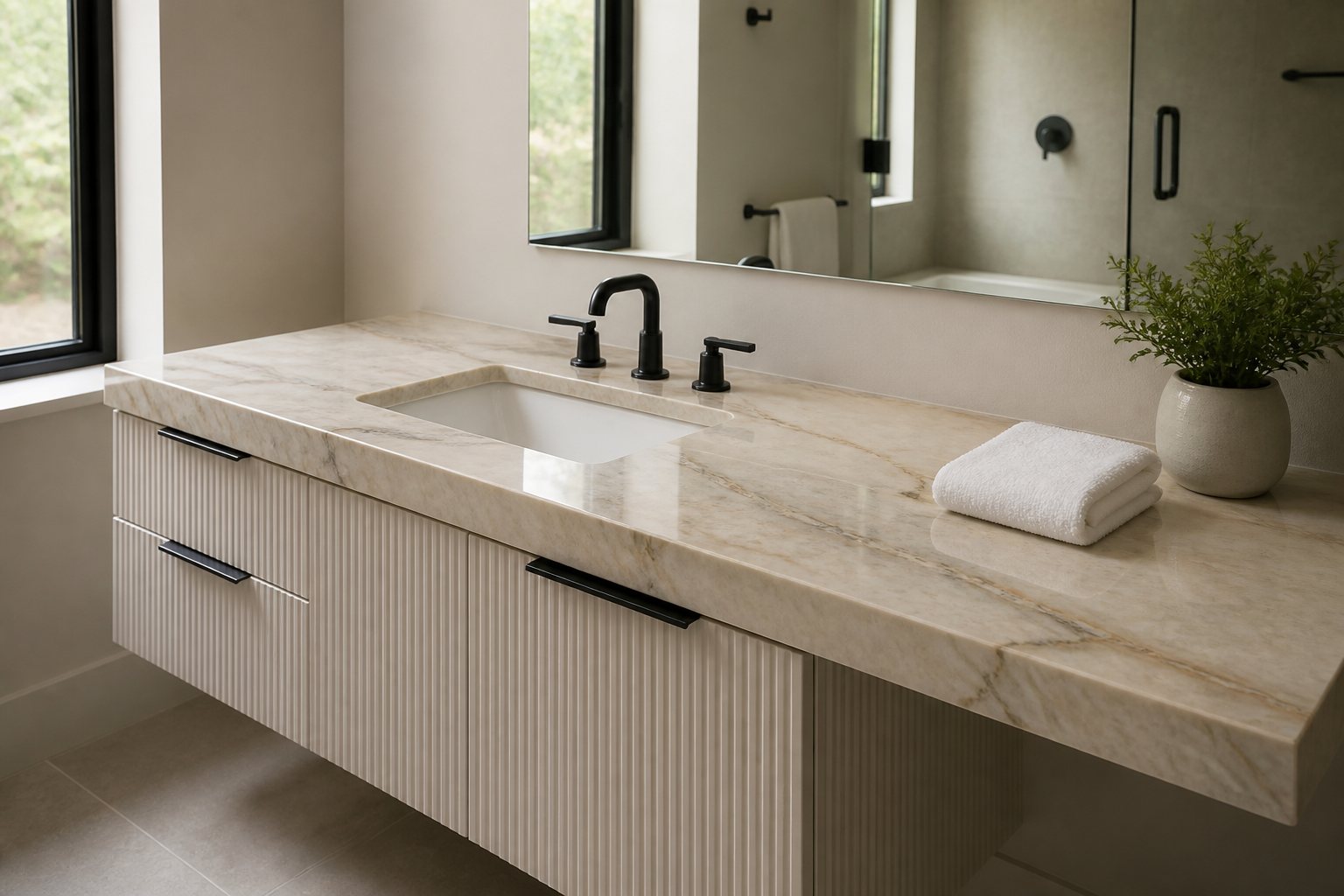
Sink, edge and splash details to lock before production
The vanity top is the one counter in the house where the sink decision comes first. An undermount basin needs the cut-out sized to the manufacturer's template, with the build-up or solid thickness confirmed around the opening. A vessel basin needs a flat, well-supported top and a correctly placed tap drilling. An integrated or moulded basin is not a quartzite detail, so it must be resolved before the slab is cut.
| Detail | What to confirm in writing |
|---|---|
| Finished top depth | Cabinet depth plus the intended front overhang, measured on the actual cabinet |
| Basin cut-out | Sink model, template reference, tap hole centres and any overflow clearance |
| Edge profile | Eased, bevelled, mitred or built-up detail, with the visible edge thickness stated |
| Backsplash | Height, whether it is a separate strip from the same slab or a full-height panel |
| Seam plan | Where seams fall on long double-basin runs, and whether vein matching is required |
A full-height splash or wall panel changes the yield calculation, because a tall splash piece may need to come from a different part of the slab than the top. If the design uses a tall splash behind a vanity, treat the vanity and the splash as one cutting exercise rather than two.
Care and sealing in a wet area
Quartzite is a natural stone. Sealing practice depends on the actual slab: some bundles take a penetrating sealer readily, while others are dense enough that the sealer sits on the surface. Ask for the sealer specification used at the factory and follow the same product family on site. In a bathroom, the practical care points are simple: wipe standing water off the surface and away from the splash joint, avoid acidic or abrasive cleaners, and use a trivet for hot tools. For a wider comparison of how natural stone and engineered quartz behave in wet areas, read quartzite vs quartz.
Engineered Taj Mahal quartz is a non-porous manufactured surface and does not need the periodic sealer routine of natural stone, which is one reason repeat bathroom programmes often choose it for guest rooms and rental units. Natural quartzite is normally chosen where the genuine stone movement is part of the design.
Ordering vanity tops factory direct
The factory minimum is one 20ft container, and mixed loading can be planned across colours, sizes and thicknesses subject to the actual arrangement. That suits buyers who need vanity tops alongside kitchen tops, table tops or slab stock in the same shipment. Production is supported by facilities in Shuitou, China and Rayong, Thailand, with four production lines, and both 2cm and 3cm are available.
For natural quartzite, approve the actual bundle. Request full-slab photos or video of the specific bundle rather than a small crop, and confirm the bundle reference on the approval sheet. For engineered quartz, confirm the batch, format, finish and current production or stock position. The Taj Mahal slab catalogue is the starting point for identifying the material family, and the inspection page explains the pre-shipment checks that support an order review.
FAQ
Can Taj Mahal quartzite be used in a bathroom?
Yes. Taj Mahal quartzite is used for vanity tops and feature wall panels in bathrooms. Specify a suitable finish, seal according to the actual slab, and keep standing water and acidic cleaners off the surface. For a shower or a wet-room floor, confirm the slip and drainage requirements with your designer or installer.
Is 2cm quartzite strong enough for a vanity top?
A 2cm top is standard when the cut-out is properly supported and the edge build-up is bonded to the fabricator's method. Where the design calls for a solid 3cm edge with no build-up, order 3cm. Provide the cabinet layout and basin template so the fabricator can confirm the detail.
Should I match the vanity top to the kitchen countertop?
This is a design decision, but ordering both from the same material schedule and the same approved bundle improves consistency and simplifies loading. A single 20ft container can carry kitchen and bathroom work together, subject to the confirmed loading plan.
Send your vanity schedule for a factory quotation. Include finished top sizes, basin model, edge profile, splash height, thickness, quantity and destination port. Message us on WhatsApp at +86 130 5543 1394 or email [email protected]. Start with the Taj Mahal slab catalogue if you need to identify the material family.